
Best Class 3 Mobility Scooters in 2026

If a Class 2 scooter doesn't give you enough range or speed, a Class 3 is the next step. These are road-legal machines that travel at up to 8 mph, cover 20 to 45 miles on a single charge, and carry riders weighing up to 227 kg. They can use roads with speed limits of 50 mph or less, giving you access to routes that pavement-only scooters simply can't reach.
The trade-off is size and regulation. Class 3 scooters must be registered with the DVLA, they need lights, indicators, and mirrors, and most weigh between 80 and 160 kg. They are not car boot scooters. These are serious machines built for daily use and longer journeys.
This guide covers the best Class 3 mobility scooters in the UK in 2026, chosen from 52 Class 3 models for the features that matter most: speed, range, weight capacity, suspension, and value.
What Makes a Class 3 Scooter Different?
Before looking at specific models, it helps to understand what separates Class 3 from the Class 2 scooters that make up most of the market. If you are not certain you need road access, it is worth reading our best Class 2 mobility scooters roundup first - a 4 mph pavement scooter is cheaper, lighter, and needs no registration.
| Feature | Class 2 | Class 3 |
|---|---|---|
| Maximum speed | 4 mph | 8 mph |
| Road use | No (pavement only) | Yes (up to 50 mph roads) |
| DVLA registration | Not required | Required (free) |
| Lights and indicators | Optional | Required |
| Mirrors | Optional | Required |
| Typical range | 6-15 miles | 20-45 miles |
| Typical weight | 20-60 kg | 80-165 kg |
| Typical price | £500-£2,500 | £1,300-£8,000 |
For a full breakdown of the legal requirements, see our licensing guide and our Class 3 reference page.
What to Look For in a Class 3 Scooter
Speed: 8 mph vs 6 mph
Not all Class 3 scooters actually reach 8 mph. Some are registered as Class 3 for road access but are limited to 6 mph. If road speed matters to you, check the top speed carefully. In our picks below, we note the actual maximum speed for each model.
Range
Class 3 scooters are built for longer journeys, so range matters more than it does for a pavement scooter. Most models deliver 20 to 35 miles, which is enough for a full day of mixed road and pavement use. A few premium models stretch past 35 miles, and the Kymco Maxer ER reaches a remarkable 45 miles.
Real-world range is always lower than the manufacturer figure. Hills, headwinds, rider weight, and cold weather all reduce it. Budget for about 70-80% of the stated range as your reliable working distance.
Weight Capacity
Class 3 scooters support significantly more weight than Class 2 models. Most handle 150 to 185 kg, with heavy-duty models reaching 200 to 227 kg. If you're near the maximum rating of a Class 2 scooter, a Class 3 gives you comfortable headroom.
Suspension
At 8 mph on UK roads, suspension is not optional. Potholes, drain covers, and rough tarmac at twice pavement speed will make an unsuspended ride uncomfortable and potentially unsafe. Full suspension (front and rear) is the standard for most Class 3 models and should be your baseline expectation.
Road-Legal Equipment
Class 3 scooters are required to have lights, indicators, mirrors, and a horn. Most models include all of these, but a few (particularly those that cross over from the folding category) may be missing indicators or mirrors. Check before you buy.
Our Top Picks
1. Drive DeVilbiss Journey - Best Budget Class 3
The Journey is the cheapest way to get a road-legal 8 mph scooter from an established brand. At £1,299 it undercuts the next cheapest Class 3 by £200, and it still delivers a 20-mile range, 8 mph top speed, and full road-legal lighting with indicators and mirrors. The 360-degree swivel seat makes mounting and dismounting easier, and the four-wheel design is stable at road speed.
Key specs:
| Spec | Value |
|---|---|
| Price | £1,299 |
| Speed | 8 mph |
| Range | 20 miles |
| Weight capacity | 135 kg |
| Weight | 111 kg |
| Suspension | Front |
| Wheels | 4 |
| Battery | Sealed-lead-acid |
| Lights / Indicators / Mirrors | Yes / Yes / Yes |
Why it stands out: Nothing else in the UK market offers Class 3 road access at this price. The 20-mile range and 8 mph speed are genuine, and Drive DeVilbiss has one of the largest dealer networks in the country.
Trade-offs: Front suspension only, which means the rear end will feel rough on poor road surfaces. The 135 kg weight capacity is on the low side for a Class 3. It does not disassemble, so you need dedicated storage space.
2. Drive DeVilbiss Envoy 8 - Best Value for Range
The Envoy 8 pairs a 30-mile range with full suspension and an 8 mph top speed for just £1,804. That combination is hard to beat at any price, let alone under £2,000. The 500W motor handles inclines comfortably, and the 160 kg weight capacity gives most riders plenty of headroom.
Key specs:
| Spec | Value |
|---|---|
| Price | £1,804 |
| Speed | 8 mph |
| Range | 30 miles |
| Weight capacity | 160 kg |
| Weight | 100 kg |
| Suspension | Full |
| Wheels | 4 |
| Battery | Sealed-lead-acid |
| Lights / Indicators / Mirrors | Yes / Yes / Yes |
Why it stands out: 30 miles of range with full suspension at this price is exceptional. Only three other Class 3 scooters match 30 miles, and they all cost at least £700 more. The full road-legal lighting package is included.
Trade-offs: Heavy at 100 kg, so it needs a permanent home rather than regular transport. Pneumatic tyres deliver a smoother ride but can puncture and need checking. Does not disassemble.
Drive sells the same chassis as the 4 mph Class 2 Envoy 4 for £1,285. If you are not certain you need road-legal speed, our Envoy 4 vs Envoy 8 comparison is the clearest way to see what the Class 3 upgrade actually costs and gains, since everything else about the two scooters is identical.
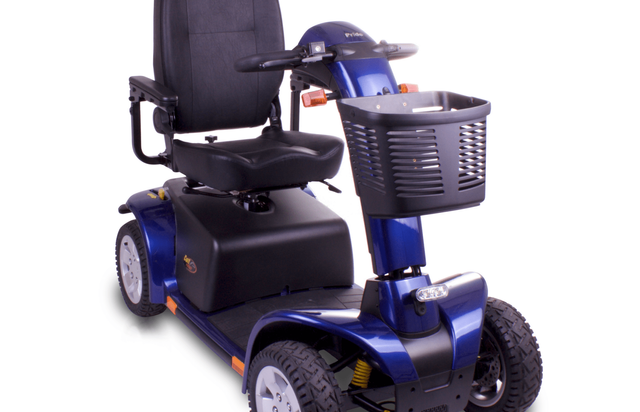
3. Pride Colt Pursuit - Best All-Rounder
The Colt Pursuit is the Class 3 scooter that covers all the bases. It delivers 30 miles of range, supports up to 181 kg, and rides on 13-inch pneumatic wheels with full suspension for a comfortable experience on mixed surfaces. The high-back fold-flat seat with headrest and seat belt is built for long days out, and the feather-touch disassembly means it can be partially dismantled for transport (though the heaviest piece at 43 kg still requires a vehicle hoist or ramp).
Key specs:
| Spec | Value |
|---|---|
| Price | £2,599 |
| Speed | 8 mph |
| Range | 30 miles |
| Weight capacity | 181 kg |
| Weight | 78.5 kg |
| Suspension | Full |
| Wheels | 4 (13-inch pneumatic) |
| Battery | Sealed-lead-acid |
| Lights / Indicators / Mirrors | Yes / Yes / Yes |
Why it stands out: The best balance of range, capacity, comfort, and brand trust in the mid-range. Pride Mobility's Colt range is one of the most popular Class 3 lines in the UK, and the Pursuit sits at the top with its 30-mile range and 181 kg capacity.
Trade-offs: The 43 kg heaviest piece when dismantled means most people will need a ramp or hoist rather than manual lifting. At 78.5 kg total it's lighter than many competitors, but this is still not a portable scooter.
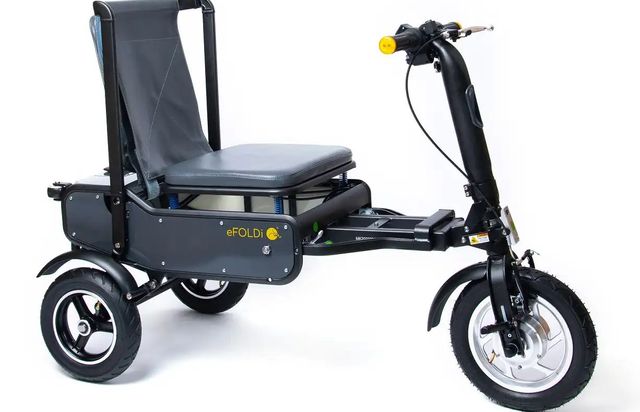
4. eFOLDi Explorer - Best Portable Class 3
The Explorer is unlike anything else in the Class 3 category. At just 17 kg (19 kg with battery), it weighs less than some Class 2 travel scooters. It folds flat, uses a lithium-ion battery, and reaches a genuine 8 mph on road. If you need Class 3 road access but also need to transport your scooter regularly, this is the only realistic option.
Key specs:
| Spec | Value |
|---|---|
| Price | £2,699 |
| Speed | 8 mph |
| Range | 14 miles |
| Weight capacity | 120 kg |
| Weight (with battery) | 19 kg |
| Suspension | Full |
| Wheels | 3 |
| Battery | Lithium-ion |
| Foldable | Yes |
| Lights / Indicators / Mirrors | Yes / No / No |
Why it stands out: The only Class 3 scooter you can fold and put in a car boot. At 19 kg it weighs less than most Class 2 scooters, yet it's road-legal at 8 mph with full suspension. The lithium-ion battery charges faster and lasts longer than sealed-lead-acid.
Trade-offs: The 120 kg weight capacity is restrictive. No indicators or mirrors fitted as standard, which you will need to add for full road-legal compliance. The 14-mile range is significantly shorter than traditional Class 3 models. The three-wheel design is less stable than four wheels at higher speeds.
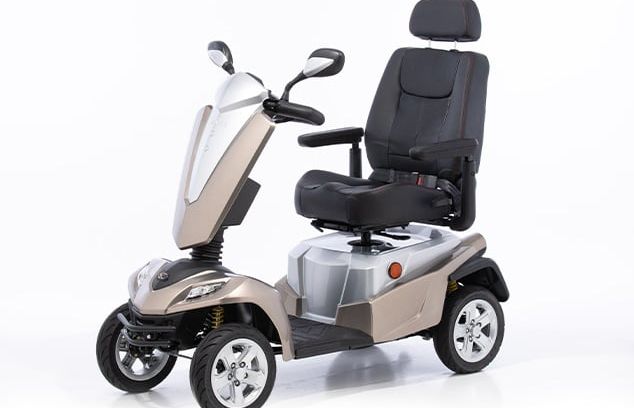
5. Kymco Maxer ER - Best Long Range
If range is your top priority, nothing in the market comes close. The Maxer ER delivers 45 miles on a single charge, nearly double the next best model in this roundup. It supports up to 200 kg, has full suspension, and handles any terrain with its heavy-duty build. For people who need to cover serious distance without worrying about running flat, this is the scooter.
Key specs:
| Spec | Value |
|---|---|
| Price | £3,495 |
| Speed | 8 mph |
| Range | 45 miles |
| Weight capacity | 200 kg |
| Weight | 153 kg |
| Suspension | Full |
| Wheels | 4 |
| Battery | Sealed-lead-acid |
| Lights / Indicators / Mirrors | Yes / Yes / Yes |
Why it stands out: 45 miles of range is in a different league. You could travel from central London to Brighton on a single charge. The 200 kg weight capacity and heavy-duty build make it suitable for larger riders who are underserved by most scooters.
Trade-offs: At 153 kg the Maxer ER is heavy even by Class 3 standards. It needs dedicated parking and is too large for most indoor spaces. The £3,495 price is significant, though justified by the extended range battery.
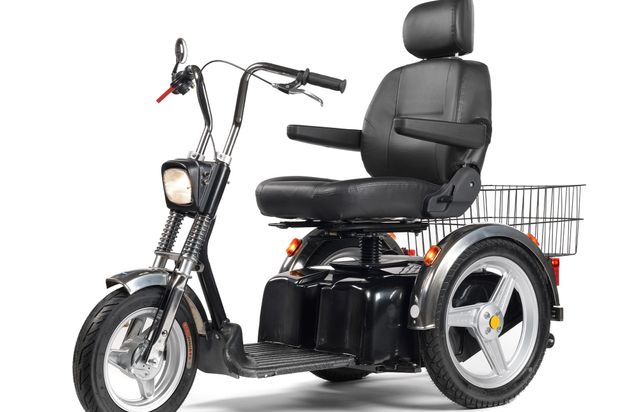
6. TGA Supersport - Best Classic Design
The Supersport is a three-wheel Class 3 scooter with the styling of a classic car. Behind the looks, it is a serious machine: 200 kg weight capacity, 8 mph top speed, and a 25-mile range. The three-wheel design gives it a tighter turning radius than four-wheel competitors, making it more manoeuvrable in town centres and tight spaces. TGA is a UK manufacturer with a strong dealer network and a reputation for build quality.
Key specs:
| Spec | Value |
|---|---|
| Price | £4,695 |
| Speed | 8 mph |
| Range | 25 miles |
| Weight capacity | 200 kg |
| Weight | 119 kg |
| Suspension | None |
| Wheels | 3 |
| Battery | Sealed-lead-acid |
| Lights / Indicators / Mirrors | Yes / Yes / Yes |
Why it stands out: The distinctive three-wheel design offers the tightest turning circle of any scooter in this roundup, and the 200 kg weight capacity matches the heavy-duty models. TGA's UK-based manufacturing means parts and servicing are straightforward.
Trade-offs: No suspension is unusual at this price and will be felt on poor road surfaces. At £4,695 it is premium-priced. The three-wheel layout is less stable than four wheels on uneven ground, though it handles well on tarmac.
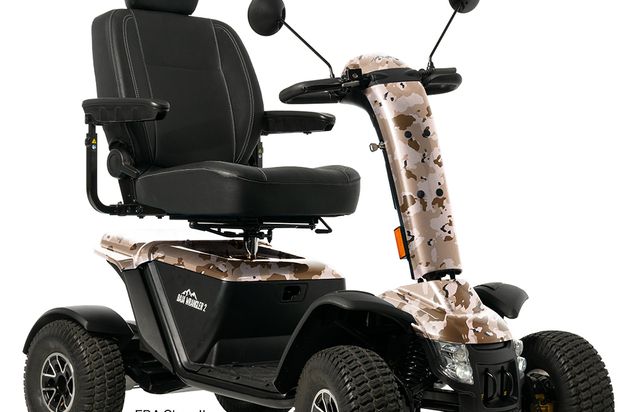
7. Pride Baja Wrangler 2 - Best Off-Road
Most Class 3 scooters are built for roads and pavements. The Baja Wrangler 2 is built for everywhere else. With full suspension, large pneumatic tyres, and a 204 kg weight capacity, it handles grass, gravel, woodland paths, and rough terrain that would stop a road scooter dead. If you live rurally or want to use your scooter outdoors beyond the pavement, this is the one designed for it.
Key specs:
| Spec | Value |
|---|---|
| Price | £4,999 |
| Speed | 8 mph |
| Range | 20 miles |
| Weight capacity | 204 kg |
| Weight | 124.3 kg |
| Suspension | Full |
| Wheels | 4 |
| Category | Off-road |
| Battery | Sealed-lead-acid |
| Lights / Indicators / Mirrors | Yes / Yes / Yes |
Why it stands out: The only off-road Class 3 scooter we found. The 204 kg capacity and rugged build make it suitable for larger riders on demanding terrain. Full road-legal equipment means you can ride it to the countryside on roads and then go off-piste.
Trade-offs: At £4,999 it is one of the most expensive Class 3 scooters. The 20-mile range is modest for the price, and the 124 kg weight makes it impractical to transport without a trailer or vehicle lift. This is a specialist machine, not an everyday pavement scooter.
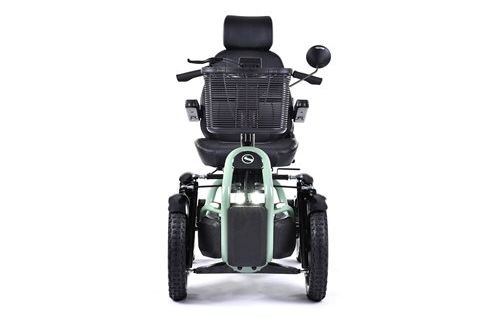
8. Sterling S800 By Scoozy - Best Luxury
The S800 is the modern take on Class 3 mobility. It uses a lithium-ion battery (still rare at this end of the market), weighs just 100 kg despite its full-size build, and delivers a 31-mile range. The design is clean and contemporary rather than the medical-equipment aesthetic of most scooters. Full suspension, an 8 mph top speed, and a 160 kg weight capacity round out a scooter that prioritises the ownership experience as much as the specifications.
Key specs:
| Spec | Value |
|---|---|
| Price | £5,995 |
| Speed | 8 mph |
| Range | 31.1 miles |
| Weight capacity | 160 kg |
| Weight | 100 kg |
| Suspension | Full |
| Wheels | 4 |
| Battery | Lithium-ion |
| Lights / Indicators / Mirrors | Yes / Yes / Yes |
Why it stands out: One of only three lithium-ion Class 3 scooters available, and by far the most refined. At 100 kg it is significantly lighter than sealed-lead-acid competitors with similar range. The modern design sets it apart visually from traditional mobility scooters.
Trade-offs: At £5,995 it is the second most expensive pick in this roundup. The 160 kg weight capacity is lower than the heavy-duty models. The lithium battery, while superior in performance, is more expensive to replace when the time comes.
Quick Comparison Table
| Model | Price | Speed | Range | Capacity | Weight | Suspension | Battery | Best For |
|---|---|---|---|---|---|---|---|---|
| Drive Journey | £1,299 | 8 mph | 20 mi | 135 kg | 111 kg | Front | Lead-acid | Budget |
| Drive Envoy 8 | £1,804 | 8 mph | 30 mi | 160 kg | 100 kg | Full | Lead-acid | Value + range |
| Pride Colt Pursuit | £2,599 | 8 mph | 30 mi | 181 kg | 78.5 kg | Full | Lead-acid | All-rounder |
| eFOLDi Explorer | £2,699 | 8 mph | 14 mi | 120 kg | 19 kg | Full | Lithium | Portability |
| Kymco Maxer ER | £3,495 | 8 mph | 45 mi | 200 kg | 153 kg | Full | Lead-acid | Long range |
| TGA Supersport | £4,695 | 8 mph | 25 mi | 200 kg | 119 kg | None | Lead-acid | Classic design |
| Pride Baja Wrangler 2 | £4,999 | 8 mph | 20 mi | 204 kg | 124 kg | Full | Lead-acid | Off-road |
| Sterling S800 By Scoozy | £5,995 | 8 mph | 31 mi | 160 kg | 100 kg | Full | Lithium | Luxury |
Which Scooter for Which Situation?
The right Class 3 scooter depends on how you plan to use it. Here is a quick guide to matching the right model to your situation.
Daily road and pavement use
If your scooter is your main form of transport for shopping, appointments, and getting around town, prioritise range and comfort. Full suspension and at least 25 miles of range will cover a full day without range anxiety.
- Best choice: Pride Colt Pursuit (30 miles, 181 kg capacity, full suspension)
- Budget choice: Drive Envoy 8 (30 miles, full suspension, under £2,000)
Longer journeys and rural roads
If you regularly cover more than 20 miles in a day, or if your routes include hills and rough roads, you need a scooter built for endurance.
- Best choice: Kymco Maxer ER (45 miles, 200 kg capacity)
- Alternative: Drive Envoy 8 or Pride Colt Pursuit (both 30 miles)
Portability and transport
Most Class 3 scooters stay in one place. If you need to transport yours regularly, the options are limited but one model stands out.
- Best choice: eFOLDi Explorer (19 kg, folds flat, fits in a car boot)
- Note: All other Class 3 models require a vehicle hoist, ramp, or trailer for transport
Off-road and rough terrain
Standard road scooters will struggle on grass, gravel, and uneven ground. If you need to leave the tarmac regularly, you need a purpose-built model.
- Best choice: Pride Baja Wrangler 2 (full suspension, large tyres, 204 kg capacity)
Ground clearance, tyre tread and motor power all matter more off the tarmac than they do on it — our guide to off-road mobility scooters explains what to check before buying for rough ground.
Higher weight capacity
If you weigh over 160 kg, your options narrow to the heavy-duty end of the Class 3 range. These models are built with reinforced frames and more powerful motors.
- Up to 200 kg: Kymco Maxer ER, TGA Supersport, or Pride Baja Wrangler 2
- Up to 227 kg: Pride Maxima 4-Wheel (£2,999, not in our top picks but worth considering for the highest capacity available)
Other Class 3 Models Worth Considering
Our eight picks cover the main use cases, but the Class 3 category runs to 52 models. A couple of others are worth a look depending on your priorities:
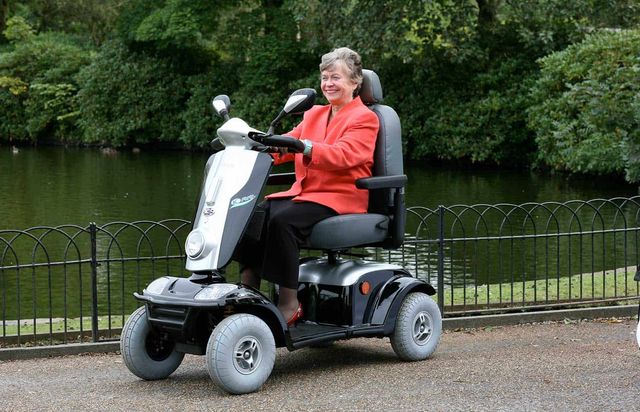
- Kymco Maxi XLS (£3,609) - a full-size road scooter with a 35-mile range, 200 kg capacity, and 12-inch pneumatic tyres. It sits just below the Maxer in Kymco's range and is a strong all-rounder for longer daily journeys.
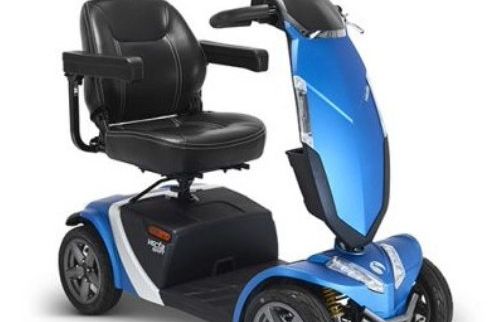
- Rascal Vecta Sport (from around £2,795) - a sporty 8 mph scooter with full suspension, run-flat pneumatic tyres, and a 27.3-mile range, for riders who want road-legal performance with a bit of styling.
- TGA Breeze S3, S4 and X (£5,195-£5,595) - the premium end of the category, with a 1400 W motor, 24-mile range, 200 kg capacity and fully active suspension on every wheel. TGA sells it in three configurations at effectively one price, so the decision is which layout suits you: our Breeze S3 vs S4 vs X comparison covers the 3-wheel, 4-wheel and all-terrain versions.
Registration and Legal Requirements
Class 3 scooters have more legal requirements than Class 2 models. Here is what you need to know:
DVLA registration
All Class 3 scooters must be registered with the DVLA using form V55/MV. Registration is free and you do not need a driving licence, MOT, or road tax. Most dealers handle the paperwork at the point of sale.
Road rules
- Maximum 8 mph on roads with speed limits of 50 mph or less
- Maximum 4 mph on pavements
- No motorways or dual carriageways
- Must have lights, indicators, mirrors, and a horn
- Must display a red rear reflector
- You must be capable of operating the scooter safely, but there is no formal test
Insurance
Insurance is not legally required, but it is strongly recommended for Class 3 scooters. You are sharing the road with cars, vans, and lorries, so third-party liability cover is particularly important. Policies start from around £50 per year.
For the complete guide to registration, road rules, and legal requirements, see our licensing guide.
Running Costs
Class 3 scooters cost more to run than Class 2 models, mainly because of their larger batteries and heavier build. Use our running cost calculator for a personalised estimate, but here is what to expect:
| Cost | Annual Estimate |
|---|---|
| Electricity (charging) | £15-£40 |
| Insurance (recommended) | £50-£200 |
| Servicing | £75-£150 |
| Battery replacement (every 1-2 years for lead-acid) | £150-£300 |
| Tyre replacement / repair | £30-£80 |
| Total | £320-£770 |
Lithium-ion batteries (eFOLDi Explorer, Sterling S800) last 3-5 years and cost more to replace upfront, but the longer lifespan often makes them cheaper over time. See our battery guide for detailed care and replacement advice.
For broader pricing context across all scooter types, see our average mobility scooter prices data and running cost calculator.
How We Chose These Scooters
Every model in this roundup meets four criteria:
- Available in the UK from established brands with dealer networks and warranty support
- Currently in production with parts and servicing readily available
- Class 3 registered with the DVLA for road use
- Full road-legal equipment (lights, indicators, and mirrors fitted or available)
We selected eight models from 52 Class 3 scooters, choosing one for each major use case: budget, value, all-round, portable, long range, premium design, off-road, and luxury. Models were evaluated on speed, range, weight capacity, suspension, build quality, and price relative to the competition.
Frequently Asked Questions
Do you need to register a Class 3 mobility scooter?
Yes. All Class 3 scooters must be registered with the DVLA using form V55/MV. Registration is free and does not require a driving licence, MOT, or road tax. Your dealer will usually handle the paperwork when you buy the scooter. For a full walkthrough of the process, see our licensing guide.
Can you drive a Class 3 mobility scooter on the road?
Yes. Class 3 scooters can travel at up to 8 mph on roads with a speed limit of 50 mph or less. They must not be used on motorways or dual carriageways. On pavements, the speed must be limited to 4 mph. Most Class 3 scooters have a switch or automatic system to reduce speed for pavement use.
Do you need insurance for a Class 3 scooter?
Insurance is not legally required, but it is strongly recommended. Class 3 scooters travel on roads alongside other vehicles, so third-party liability cover is particularly important. Basic policies start from around £50 per year, with comprehensive cover costing £80-£200 per year.
What is the difference between Class 2 and Class 3?
Class 2 scooters are limited to 4 mph and pavement use only. They do not need to be registered. Class 3 scooters can travel at up to 8 mph on roads, must be registered with the DVLA, and are required to have lights, indicators, mirrors, and a horn. Class 3 models are typically larger, heavier, and have longer range. See our Class 2 and Class 3 pages for full details.
How fast does a Class 3 mobility scooter go?
The legal maximum is 8 mph on roads. On pavements, the speed must be limited to 4 mph. Some Class 3 scooters are limited to 6 mph even on roads, so check the top speed before buying if road speed matters to you. All eight models in this roundup reach the full 8 mph.
Is a Class 3 scooter better than a Class 2?
It depends on what you need. If you only use pavements and make short local trips, a Class 2 scooter is lighter, cheaper, and easier to transport. If you need to travel on roads, cover longer distances, or require a higher weight capacity, a Class 3 is the better choice. Many people own both: a portable Class 2 for car boot travel and a Class 3 for daily road use.
Can I take a Class 3 scooter on public transport?
Most UK bus and train operators accept mobility scooters, but size limits apply. Trains typically require scooters under 120 cm long and 70 cm wide. Most Class 3 scooters exceed these dimensions, with the exception of the eFOLDi Explorer (which folds to a compact size). Check with your local transport provider before travelling.
How much does a Class 3 mobility scooter cost?
Prices range from £1,299 for a basic road-legal model (Drive Journey) to over £7,900 for premium luxury scooters (Sterling Elite 2 Plus). Most popular models sit between £2,000 and £4,000. See our average mobility scooter prices for a broader overview of mobility scooter pricing across all categories.
Related Models
Pride Mobility
Baja Wrangler 2
Pride Mobility
Colt Pursuit
Drive DeVilbiss
Envoy 8
eFOLDi
Explorer
Drive DeVilbiss
Journey
Kymco Healthcare
Maxer ER
Kymco Healthcare
Maxi XLS
Sterling
S800 By Scoozy
TGA Mobility
Supersport
Rascal Mobility