
Can You Take a Mobility Scooter on Public Transport?
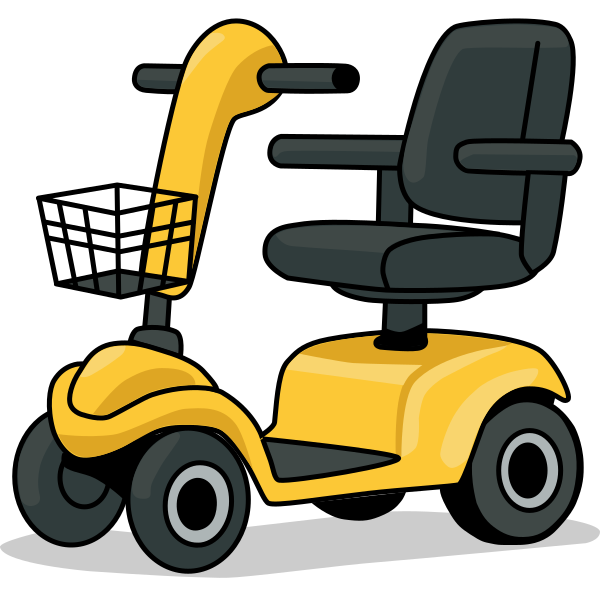

Yes, you can take a mobility scooter on most forms of public transport in the UK -- but every operator has its own rules about size, weight, permits, and which scooter classes are allowed. Getting turned away at the stop or the station because your scooter is 5 cm too wide or you don't have the right permit is frustrating, and it is entirely avoidable.
This guide covers the rules for buses, trains, trams, and ferries across the UK, including the specific limits set by major operators, so you can check before you travel.
The Two Things That Matter Most
Before checking individual operators, you need to know two things about your scooter:
- Its dimensions -- specifically the length, width, and turning radius. Measure these yourself rather than relying on the manufacturer's figures, especially if you have added a basket, canopy, or other accessories.
- Its class -- Class 2 or Class 3. Class 2 scooters (4 mph, pavement only) are accepted on most public transport. Class 3 scooters (8 mph, road legal) are larger and heavier, and many operators will not allow them. Your class also determines where you can legally ride once you are off the bus or train.
If you have a folding scooter, measure it both unfolded and folded. A scooter that is too large when unfolded may still be allowed on board if you fold it before boarding, since folded scooters are often treated as luggage.
Buses
Most UK bus operators follow the Confederation of Passenger Transport (CPT) Code, which sets a standard size limit for mobility scooters in the wheelchair space:
- Maximum length: 100 cm
- Maximum width: 60 cm
- Maximum turning radius: 120 cm
- Maximum combined weight (scooter + rider): 300 kg
- Class 2 only
Within these limits, you can board the bus and travel in the designated wheelchair/mobility aid space. Class 3 scooters are almost always too large.
Operator-Specific Policies
| Operator | Max Size | Permit Required | Notes |
|---|---|---|---|
| Arriva | 100 x 60 cm | Yes (scooter pass) | Ramp weight limit varies by vehicle |
| First Bus | 100 x 60 cm | Yes (Permit for Travel photo card) | 300 kg combined weight limit |
| Stagecoach | 100 x 60 cm | Yes (photo card, valid 5 years) | 300 kg combined weight limit |
| Go North East | 120 x 70 cm | No | More generous than the CPT standard |
| Brighton & Hove | 100 x 60 cm | Yes (in-person assessment) | Weight limit not published |
| TfL Buses (London) | 100 x 60 cm | Yes (Mobility Aid Recognition card) | Approx. 86 approved scooter models |
| Lothian Buses (Edinburgh) | Folding only | No | Unfolded scooters not permitted |
| National Express (coaches) | Must fold for hold | No (book 36 hrs ahead) | Each part max 20 kg. Dry cell, gel, or lithium batteries only |
How to Get a Bus Permit
Most bus companies issue scooter travel permits free of charge. The process typically involves:
- Filling in an application form (usually available on the operator's website or at a travel centre).
- Providing your scooter's make, model, and dimensions.
- In some cases, attending a short in-person assessment where staff check your scooter fits in the wheelchair space and you can board safely.
The permit is usually a photo card that you show to the driver when boarding. Stagecoach permits are valid for five years; others vary.
Key Points for Bus Travel
- Wheelchair users have priority for the wheelchair space. If a wheelchair user needs the space, you may be asked to wait for the next bus.
- Folding scooters that are fully folded may be allowed on buses that would otherwise refuse them, since they are treated as luggage rather than a mobility aid in the wheelchair space.
- Go North East stands out with its 120 cm x 70 cm limit, matching the wheelchair space dimensions. If your scooter is slightly too large for other operators, check whether Go North East covers your route.
Trains
Train travel is more accommodating than buses. Most UK train operators follow the National Rail standard, which is based on the "reference wheelchair" dimensions:
- Maximum length: 120 cm
- Maximum width: 70 cm
- Maximum combined weight (scooter + rider): 300 kg
This is significantly more generous than the bus limit, and most Class 2 scooters will fit within it.
Operator-Specific Policies
| Operator | Max Size | Permit Required | Class Restriction |
|---|---|---|---|
| Avanti West Coast | 120 x 70 cm | No (Passenger Assist recommended) | None stated |
| LNER | 120 x 70 cm | No | None stated |
| Great Western Railway | 120 x 70 cm | Yes (not needed if scooter is folded) | None stated |
| CrossCountry | 120 x 70 cm | No | None stated |
| Northern | 120 x 70 cm | Yes ("Rail Ready" permit) | Class 2 only |
| ScotRail | 104 x 56 cm | Confirm at booking | Class 2 only |
| Southeastern | 120 x 70 cm | No | None stated |
| South Western Railway | 120 x 70 cm | Yes | Class 1 and 2 only |
| TransPennine Express | 120 x 70 cm | Yes ("Scooter Card") | Class 2 referenced |
| Chiltern Railways | 120 x 70 cm | No | None stated |
| Greater Anglia | 120 x 70 cm | Not stated | None stated |
| Eurostar | 120 x 70 cm | No (book accessible space) | None stated |
ScotRail: The Exception
ScotRail has significantly tighter limits than every other UK train operator: 104 cm x 56 cm, and canopies and rear baskets are banned. Many standard-sized scooters that fit comfortably on other train services will not qualify for ScotRail. If you are travelling in Scotland, measure your scooter carefully and contact ScotRail before your journey.
Key Points for Train Travel
- Book Passenger Assist. Even when a permit is not required, booking Passenger Assist through National Rail ensures staff are ready to help you board and disembark. You can book online, by phone, or through the app.
- Folding scooters bypass most restrictions. If your scooter is folded, it is treated as luggage by most operators. Northern, GWR, and TransPennine Express all confirm this.
- Class 3 restrictions exist on Northern, South Western Railway, and ScotRail. Other operators do not publish a class restriction, but if your Class 3 scooter exceeds the size limits, it will not be allowed on regardless.
- Replacement bus services use stricter bus limits. If your train is replaced by a bus, the 100 x 60 cm bus standard applies, not the train standard.
Trams and Light Rail
Tram policies are the most inconsistent of any transport mode. Some follow the generous train standard, others use the tighter bus limits, and a few have their own rules entirely.
| Operator | Max Size | Permit Required | Class Allowed |
|---|---|---|---|
| TfL (Tube, DLR, Elizabeth line, Overground) | 120 x 70 cm | Yes (Mobility Aid card) | Class 2 + selected Class 3 |
| TfL (Croydon Tramlink) | ~100 x 60 cm | No | Electric only |
| Manchester Metrolink | Assessed individually | Yes (mandatory, includes on-tram training) | Class 2 only |
| Nottingham Express Transit | No fixed limit | No | All classes |
| Sheffield Supertram | 100 x 60 cm | Yes (CPT permit) | Class 2 only |
| West Midlands Metro | 100 x 60 cm | Yes (mandatory, 5-year card) | Class 2 only |
| Edinburgh Trams | 120 x 70 cm | Yes (mandatory, free) | Class 2 only |
| Blackpool Tramway | 100 x 60 cm | Yes (assessment/pass) | Class 2 only |
| Tyne and Wear Metro | Folding only | No | Unfolded scooters banned |
Standout Operators
- Nottingham Express Transit is the most permissive tram operator in the UK -- no fixed size limits and all scooter classes allowed.
- TfL rail services (Tube, DLR, Elizabeth line, Overground) use the generous 120 x 70 cm train standard, not the tighter bus limits.
- Tyne and Wear Metro effectively bans standard scooters. Only folding scooters that are fully folded before boarding are permitted.
- Manchester Metrolink does not publish fixed dimensions. Instead, they assess each scooter individually and require you to complete on-tram training before issuing a permit.
Ferries
Ferries are the most relaxed form of public transport for mobility scooter users. No UK ferry operator publishes strict size or weight limits, and the main requirement is 48 hours advance notice.
| Operator | Onboard Use | How to Book |
|---|---|---|
| P&O Ferries | Yes (lifts to all decks) | 48 hrs notice |
| DFDS | Yes (passenger areas or car deck) | Notify at booking. Max 5 wheelchair passengers per vessel |
| Stena Line | Yes | 48 hrs notice |
| Irish Ferries | Yes (lift max 148 x 110 cm) | 48 hrs notice |
| CalMac | Yes | 48 hrs notice |
| Wightlink | Yes on car ferries | 48 hrs notice |
| Red Funnel | Yes (Red Jet: max 2 wheelchairs per sailing) | 48 hrs notice |
| Brittany Ferries | Yes | Notify before travel |
| Condor Ferries | Yes (lifts from car deck) | 48 hrs notice |
Key Points for Ferry Travel
- No battery restrictions apply on ferries (unlike airlines).
- Charging onboard is generally not permitted, so charge your scooter fully before you board.
- Oversized scooters that do not fit in passenger areas stay on the car deck. The ferry operator will provide a manual wheelchair for the journey.
- Irish Ferries is the only operator that publishes a specific dimension for its wheelchair lift: 148 x 110 cm.
Flying With a Mobility Scooter
Airlines carry mobility scooters free of charge, but the rules are more complex than any other transport mode. Battery type, scooter dimensions, and cargo door size all come into play.
The key points:
- 48 hours minimum notice (some airlines recommend several weeks).
- Lithium-ion or dry cell/gel batteries required. Spillable wet cell batteries are generally banned.
- Removable lithium-ion batteries must be carried in the cabin, not in the hold.
- Size limits vary widely. British Airways is the most generous (140 x 85 x 152 cm), while Ryanair requires scooters to collapse to 81 x 119 x 119 cm.
For the full breakdown of airline policies, battery rules, and packing tips, see our dedicated guide: Taking Your Mobility Scooter on Holiday.
Which Scooters Are Best for Public Transport?
If you plan to use public transport regularly, your scooter choice matters. The critical measurements are the bus standard of 100 x 60 cm (the tightest common limit) and the train standard of 120 x 70 cm.
Folding and travel scooters are by far the best option for public transport. Many fold down to dimensions well within bus limits, and when folded they bypass permit requirements on several train operators.
Here is what to look for:
- Length under 100 cm and width under 60 cm if you want to use buses.
- Lithium-ion battery if you plan to fly.
- Weight under 25 kg per component if you need to fold and stow it.
- Turning radius under 120 cm for bus wheelchair spaces.
For scooter recommendations by use case, see our guides to the best lightweight scooters for travel and best car boot scooters.
Your Rights on Public Transport
The Equality Act 2010 requires transport operators to make reasonable adjustments for disabled passengers. This means:
- Operators cannot refuse to carry you simply because you use a mobility scooter, provided your scooter meets their published size and weight requirements.
- Drivers must provide reasonable assistance with boarding and disembarking.
- Under the Taxis and Private Hire Vehicles (Disabled Persons) Act 2022, taxi and private hire drivers must accept disabled passengers and carry mobility aids without extra charge. Fines of up to £1,000 apply for non-compliance.
If you are refused access to a service and believe the refusal was unreasonable, you can contact the Equality Advisory Support Service for free advice.
Planning Checklist
Before your first journey on public transport with your scooter:
- Measure your scooter's length, width, and turning radius (including any accessories).
- Check which class your scooter is (Class 2 or Class 3).
- Look up your operator's size limits and class restrictions in the tables above.
- Apply for any required permits (usually free, allow a few weeks for processing).
- Book Passenger Assist for train travel.
- Fully charge your battery -- see our battery guide for range advice.
- Carry your permit, phone, and a copy of your scooter's dimensions.
With the right preparation, public transport opens up far more of the UK than your scooter's battery range alone. The rules vary by operator, but once you have the right permit and know your scooter fits, the process becomes routine.