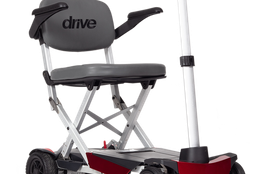
Drive InstaFold vs AutoFold (2026): Which Auto-Folding Scooter?

Quick verdict. The Drive InstaFold and AutoFold do the same headline trick: press a button on a remote and the scooter folds itself down for the car boot, no lifting or latching. Both are Class 2, 4mph, four-wheel pavement scooters on lightweight lithium batteries. The big difference is the price: the InstaFold is £745 and the AutoFold is £1,440, almost double. For that extra ~£695 the AutoFold gives you a slightly higher 125kg weight capacity, a more refined and proven fold mechanism, and an upgrade path to suspension and lighter models. The InstaFold counters with a slightly longer 10-mile range, a lighter 25kg body, and a price that lands it firmly in the "automatic folding scooter under £1,000" bracket most buyers are searching for. Choose the InstaFold if you want one-touch remote folding for the least money. Choose the AutoFold if you are taller, heavier, or want the more established platform.
At a glance: InstaFold vs AutoFold
| Spec | Drive InstaFold | Drive AutoFold |
|---|---|---|
| Price (VAT exempt) | from £745 | from £1,440 |
| Folding | automatic, remote fob | automatic, remote + tiller button |
| Class / top speed | Class 2 / 4mph | Class 2 / 4mph |
| Range | up to 10 miles | up to 9.3 miles |
| Weight capacity | 120 kg (18.9 st) | 125 kg (19.7 st) |
| Scooter weight | 25 kg | 27.5 kg |
| Wheels | 4 | 4 |
| Tyres | solid (puncture-proof) | solid (puncture-proof) |
| Suspension | none | none |
| Battery | 24V 10Ah lithium-ion | 25.2V 10Ah lithium-ion |
| Charging | off-board | off-board |
| Warranty | 2 years | 2 years |
| Best for | lowest-cost auto-folding | taller/heavier users, proven build |
Both are airline-friendly travel scooters that come apart for no one: there is nothing to lift, because the scooter folds itself. The decision here is not really about features, because they share almost all of them. It is about price versus build and capacity.
First, what "automatic folding" actually means
"Folding mobility scooter" covers two very different things, and the gap matters when you are spending hundreds of pounds.
- Manual-fold scooters (like the Drive Manual Fold+) collapse when you pull a lever or strap and fold the frame down by hand. They are usually the lightest and cheapest, but you still have to physically bend and fold them.
- Automatic (powered) folding scooters like the InstaFold and AutoFold fold and unfold by themselves. You press a button on a remote key fob and a motor in the frame does the work while you watch. No bending, no lifting the frame, no trapped fingers.
Both scooters here are firmly in the second camp. That is the whole point of them, and it is why they cost more than a basic manual-fold travel scooter. If you have limited grip, a bad back, or you are folding the scooter solo at the kerbside several times a day, that powered mechanism is the feature you are paying for.
The thing most buyers get wrong is assuming the cheaper InstaFold must be a manual or "assisted" fold. It is not. Both fold automatically by remote. That is exactly why this comparison is interesting: the InstaFold delivers the headline feature for roughly half the AutoFold's price.
The InstaFold: the budget auto-folder
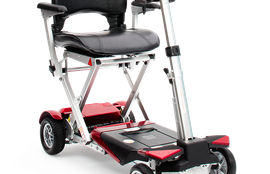
The InstaFold is one of the most affordable true remote-folding scooters on the UK market at £745. Press the key fob and it folds or unfolds in seconds; there is also a button on the battery pack as a backup if the fob is not to hand.
What you get for the low price:
- Genuine one-touch remote folding, the same core feature as scooters costing far more
- Ultra-light 1.8kg lithium batteries, easy to lift out and carry separately, and airline-friendly
- Up to 10 miles of range, slightly more than the AutoFold, which is plenty for shops, appointments and a day out
- Four wheels and solid puncture-proof tyres for a stable, no-maintenance ride on pavements
- A light 25kg body that fits into a small car boot
The trade-offs are honest ones for the money. There is no suspension, the wheels are small so it is happiest on smooth pavements and indoors, the weight capacity is 120kg, and Drive recommends it for users 5ft 10in and under. Within those limits it is a lot of convenience for the price.
For where it sits against other sub-£1,000 options, see our best mobility scooter under £1,000 roundup.
The AutoFold: the established premium version
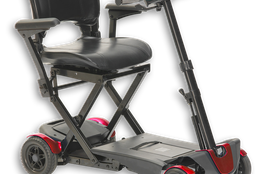
The AutoFold is the better-known, longer-established model in Drive's powered-folding range, and at £1,440 it asks for roughly double the InstaFold's price. It folds and unfolds in under 15 seconds at the touch of a button, operated either from the remote or from a button on the tiller, and packs down to a compact 45 x 57 x 64 cm for the boot.
What the extra money buys:
- A higher 125kg weight capacity and headroom for taller riders than the InstaFold's 5ft 10in guidance
- A more refined and proven fold mechanism with the tiller-button option as well as the remote
- Rear anti-tip wheels and an anti-rollback system for confidence on slopes
- An upgrade path within the same family, which the InstaFold does not have
That last point matters if you are unsure. The AutoFold is the entry model in a range: the AutoFold Elite (£1,570) adds front and rear suspension and an LCD display, and the AutoFold Pro (£1,690) drops the weight to 24.5kg and adds contactless card folding. If you might want suspension or a lighter lift later, the AutoFold family is where those options live — our best mobility scooters with suspension guide covers the Elite alongside the other folding scooters that don't skip it.
What it does not give you over the InstaFold is more range (it is actually slightly less, at 9.3 miles), suspension on the base model, or a lighter body. So the AutoFold premium is about capacity, polish and platform, not raw numbers on a spec sheet.
Range, speed and the law
Both are Class 2 mobility scooters. In the UK that means:
- A 4mph top speed, for pavement and indoor use (pedestrian areas, shops, around the home)
- No DVLA registration, no road tax, and no driving licence required
- Not designed for use along the road, except to cross it
The practical range figures are close: 10 miles for the InstaFold and 9.3 miles for the AutoFold. Both numbers are best-case, measured for a lighter rider on flat ground; expect less in the real world with hills, cold weather and a heavier load. Either way, both are sized for short, local trips and travel days, not all-day touring. Our battery guide explains what eats into that range in practice.
For the full rundown of what Class 2 means and where you can ride, see do you need a licence for a mobility scooter.
Comfort and ride quality
This is the one area where neither scooter is trying to impress, and they are evenly matched.
- No suspension on either base model, so both transmit bumps, kerbs and rough paving. They are at their best on smooth surfaces.
- Solid, puncture-proof tyres on both, which you never have to inflate or repair but which ride firmer than pneumatic tyres.
- Standard padded seats, comfortable for short trips rather than hours in the saddle.
If a smoother ride matters, the AutoFold Elite is the relevant step up because it adds front and rear suspension to the same automatic-folding format. Within this head-to-head, though, comfort should not decide it: the base InstaFold and AutoFold feel similar on the move.
Travel, transport and storage
Both scooters are built for exactly this, and both handle it well:
- By car: each folds itself down and lifts into a boot at 25 to 27.5kg. Tip the lighter lithium batteries out first to make the lift easier.
- By plane, cruise or coach: both are sold as airline-friendly thanks to their lithium batteries. Always confirm the watt-hour limit and battery rules with your airline or cruise line before you travel, as policies vary.
- Storage: both pack down small and can live in a hallway, a car boot or a cupboard with a socket nearby for off-board charging.
If you specifically want the smallest, lightest package for frequent flying, also weigh up our best lightweight mobility scooters for travel and the wider foldable scooter buying guide.
Which one should you buy?
Choose the Drive InstaFold if:
- You want automatic remote folding for the least money (£745)
- You are 5ft 10in or under and within the 120kg weight limit
- You value the slightly longer 10-mile range and the lighter 25kg body
- Your routine is shops, appointments and the occasional travel day on smooth ground
Choose the Drive AutoFold if:
- You are taller or heavier, or want the extra headroom of a 125kg capacity
- You want the more established, more refined fold mechanism and tiller-button option
- You might later want suspension (Elite) or a lighter model (Pro) from the same family
- You are happy to pay around £695 more for build and capacity rather than spec-sheet numbers
For most budget buyers, the honest answer is that the InstaFold delivers the core promise, true one-touch remote folding, airline-friendly lithium and a car-boot-sized fold, for roughly half the price. The AutoFold earns its premium only if you need the higher capacity, you are taller, or you want the proven platform and its upgrade path. Both do the one thing that makes a powered-folding scooter worth it: they fold themselves, so you never have to.
Explore these and similar folding scooters
Browse full specs and reviews, or line any two up side by side with our comparison tool:
- Drive InstaFold: the budget automatic remote-folding scooter
- Drive AutoFold: the established powered-folding model
- Drive AutoFold Elite: AutoFold with front and rear suspension
- Drive AutoFold Pro: the lightest AutoFold with contactless folding
- Drive Manual Fold+: the cheaper manual-fold alternative
For a wider shortlist, see our best mobility scooter under £1,000 and foldable scooter buying guide, or compare any two scooters side by side.