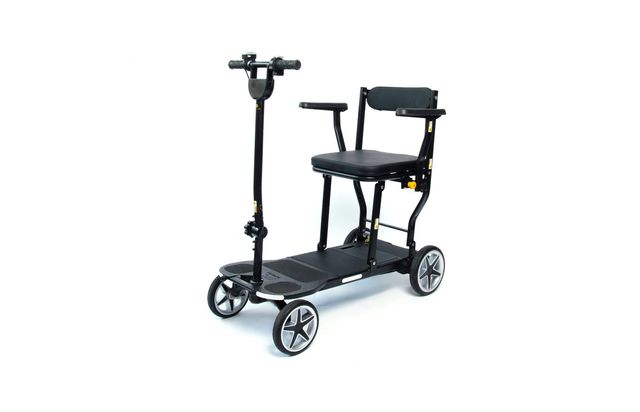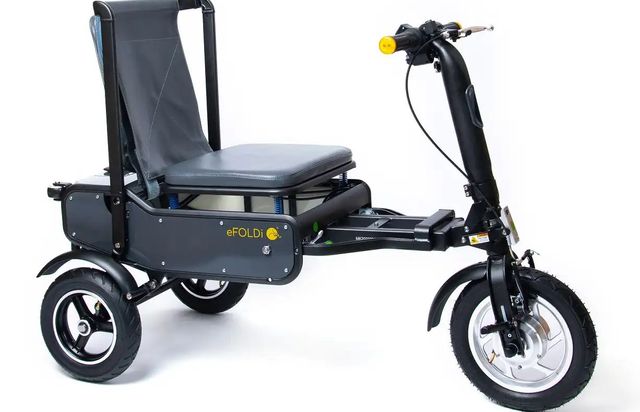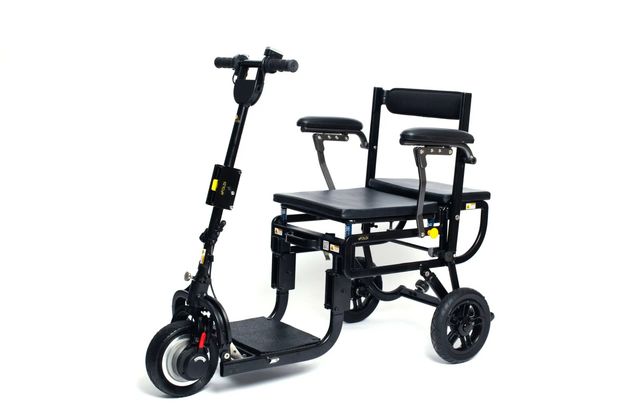
eFOLDi Mobility Scooters 2026: Full Range from £2,499

eFOLDi is a British manufacturer with one idea and three scooters built around it: make a mobility scooter light enough that an ordinary person can actually lift it. The range starts at £2,499 and tops out at £2,699, which is a lot of money for a 4 mph pavement scooter — and the reason why is the whole story of the brand.
This guide gives you the current prices, explains what you are paying for, and walks through the two decisions that actually matter when choosing between the three models.
eFOLDi Prices at a Glance (2026)
| Model | Class | Price (VAT relief) | Weight with battery | Suspension | Range |
|---|---|---|---|---|---|
| Compass | 2 | £2,499 | 13 kg | None | 10 miles |
| Lite | 2 | £2,699 | 16 kg | Full (4-point seat) | 10 miles |
| Explorer | 3 | £2,699 | 19 kg | Full | 14 miles |
Those are the VAT-relief prices — the figures eFOLDi advertises, and what you pay if you qualify for VAT exemption. If you do not qualify, add VAT on top (see VAT relief below).
Two things jump out of that table, and they are the two decisions this guide is really about:
- The Compass and the Lite are £200 apart — and the cheaper one is the lighter one.
- The Lite and the Explorer cost exactly the same £2,699 — so the choice between them is nothing to do with budget.
What You Are Actually Paying For
At £2,499 to £2,699, an eFOLDi costs more than most Class 3 road scooters with four times the range. On a spec sheet that looks indefensible. Two features explain it.
The magnesium alloy frame. The Compass weighs 11 kg on its own, 13 kg with the battery in. For comparison, a typical "lightweight" folding scooter runs 19 to 25 kg. That difference is what decides whether you can lift the thing into a car boot unaided, or whether you need a companion, a ramp or a hoist every single time. If you are buying alone and lifting alone, it is not a marginal improvement — it is the entire point.
The Airsafe battery. Every eFOLDi ships with a lithium-ion battery designed to meet airline carriage requirements, and the whole range folds small enough to travel as checked mobility equipment. That makes eFOLDi one of the few brands you can realistically plan a flight around. You still have to clear it with your airline in advance — rules vary by carrier — but see our guide to taking your scooter on holiday for how that process works in practice.
What you are not paying for is range, power or capacity. Ten miles is modest, 4 mph is the legal Class 2 maximum that every pavement scooter hits, and the 120 kg user weight limit is low. eFOLDi optimises hard for portability and gives up almost everything else to get there. That is a good trade for some buyers and a bad one for others.
Decision One: Compass or Lite?
This is the choice most eFOLDi buyers face, and the £200 price gap is the least interesting thing about it. The specs run in opposite directions:
| Compass (£2,499) | Lite (£2,699) | |
|---|---|---|
| Wheels | 4 | 3 |
| Weight with battery | 13 kg | 16 kg |
| Suspension | None | 4-point floating seat |
| Tyres | Solid | Solid |
| Frame | Magnesium alloy | Magnesium alloy |
The cheaper Compass is lighter and has an extra wheel. The pricier Lite is heavier, has one fewer wheel, and adds suspension. So this is not a good-better-best ladder — it is a genuine fork, and which way you go depends on one question: how rough is the ground you ride on?
- Choose the Compass if lifting is your main concern, or if you want the extra stability of a fourth wheel. At 13 kg it is the lightest scooter eFOLDi makes, and the 4-wheel layout is more forgiving on cambered pavements. The cost is ride comfort: with no suspension and solid tyres, you feel every paving slab.
- Choose the Lite if your local pavements are rough and you will be riding for more than a few minutes at a time. The 4-point floating seat suspension is a real comfort upgrade on broken ground, and it adds an auto turn-speed reducer that drops to 2 mph on tight turns. The cost is 3 kg of lift weight and a 3-wheel layout that is less stable on a camber.
That 3-wheel versus 4-wheel trade-off is worth understanding properly before you commit — our guide to 3-wheel vs 4-wheel mobility scooters covers it in full. And if ride comfort is what is driving your decision, the Lite is not your only option; solid tyres limit how much any suspension can do, and our best mobility scooters with suspension roundup compares the Lite and Explorer against other folding models that prioritise comfort the same way.
Decision Two: Lite or Explorer, at the Same £2,699?
Because the price is identical, this comes down purely to where you intend to ride.
| Lite (£2,699) | Explorer (£2,699) | |
|---|---|---|
| Class | 2 (pavement) | 3 (road legal) |
| Top speed | 4 mph | 8 mph |
| Range | 10 miles | 14 miles |
| Tyres | Solid | Pneumatic |
| Lights | None | Headlight + hazards |
| Weight with battery | 16 kg | 19 kg |
| DVLA registration | Not required | Required |
The Explorer is the more capable machine on almost every line: faster, longer-legged, better tyres for uneven ground, and legal on the road. It also carries a USB charging port. What it costs you is 3 kg of lift weight — which, on a scooter you bought specifically because it is light, is not a small thing — plus pneumatic tyres that can puncture and need pressure checks, and a free but mandatory DVLA registration.
Take the Explorer if you will genuinely use the road, or if your routes include rough or unmade ground where pneumatic tyres earn their keep. Take the Lite if you are a pavement rider and every kilogram counts. If you are unsure which class you need, our Drive Envoy 4 vs Envoy 8 comparison is the clearest illustration on the site — same chassis, with class as the only variable — and where can you legally drive a mobility scooter covers the rules for each.
The Limits That Apply to Every eFOLDi
These are consistent across all three models, and they are the things most likely to rule the brand out for you:
- 120 kg (18 st 12 lb) maximum user weight. This is the big one. There is no heavier eFOLDi to step up to, so if you are near this figure the brand simply is not for you — look instead at our heavy-duty roundup.
- No basket, no mirrors, no indicators, no horn as standard on any model. For a scooter you shop with, that matters more than it sounds.
- Modest range. Ten miles on the Compass and Lite, 14 on the Explorer. If range is a priority, see our longest-range roundup — plenty of scooters at this money do three to five times the distance.
- A 2-year warranty across the range, with a longer 7-year battery warranty on the Compass.
None of these is a defect. They are the direct consequence of building the lightest scooter possible — every bracket, basket and mirror is weight. But they should be a conscious trade, not a surprise after delivery.
How eFOLDi Compares to Other Brands
eFOLDi competes at the top of the folding market, where the rivals are Kymco's auto-folders and Pride's compact travel range. We have covered both head-to-heads in detail:
- eFOLDi Compass vs Pride Go-Go — the ultralight bi-fold against the established compact travel scooter.
- Kymco K-Lite FE vs eFOLDi Compass — powered auto-folding at £3,059 against the 13 kg manual bi-fold.
The pattern across both is the same. If lift weight is your binding constraint, eFOLDi wins and it is not close. Nothing from Pride, Kymco or CareCo gets near 13 kg. If your constraint is anything else — budget, range, carrying capacity, user weight — one of the mainstream brands will serve you better for less money. CareCo in particular starts under £600, and our under-£1,000 guide covers that end of the market.
For the wider folding category, including models that fold at the touch of a button, see the foldable scooter buying guide and our best car boot scooters roundup.
VAT Relief and Funding
If you have a long-term illness or disability, you can buy any eFOLDi free of VAT under UK law. eFOLDi advertises its prices on this basis, so the £2,499 and £2,699 figures throughout this guide are what an eligible buyer pays. If you do not qualify, expect roughly £500 on top for the Compass and £540 for the Lite and Explorer.
Qualifying conditions include arthritis, MS, heart disease and COPD among many others; being elderly on its own does not qualify. You declare eligibility at the point of purchase. Because retailers differ in whether they advertise VAT-inclusive or VAT-relief prices, always confirm which basis a quoted price is on before comparing it against another brand.
At these prices it is worth checking what else you can access. Our funding guide covers grants, charitable support and the Motability position, and the cost guide sets eFOLDi's pricing in the context of the wider market.
Which eFOLDi Should You Buy?
| Your priority | Model | Why |
|---|---|---|
| The lightest possible lift | Compass | 13 kg with battery, the lightest eFOLDi makes |
| Stability on cambered pavements | Compass | The only 4-wheel model in the range |
| Comfort on rough ground | Lite | 4-point floating seat suspension |
| Road use at 8 mph | Explorer | Class 3, headlight and hazards |
| Most range | Explorer | 14 miles against 10 |
| Air travel | Any | Airsafe battery across the range |
The honest summary: buy an eFOLDi if you need to lift it yourself. That is the problem this brand solves, it solves it better than anyone, and the price is what that engineering costs. If you can leave your scooter at home between uses, or someone else loads it for you, £2,500 buys a great deal more scooter elsewhere.
Whichever way you go, try to sit on one before you buy — the 120 kg limit and the narrow, minimal frames suit some riders far better than others. You can see the full range on the eFOLDi UK website or browse the eFOLDi models we track.
Frequently Asked Questions
How much does an eFOLDi mobility scooter cost? The Compass is £2,499; the Lite and Explorer are both £2,699. These are VAT-relief prices — what you pay if you qualify for VAT exemption. Add roughly £500 and £540 respectively if you do not.
What is the difference between the Compass and the Lite? The £200 gap buys suspension but costs you a wheel. The Compass is 4-wheel, 13 kg, no suspension. The Lite is 3-wheel, 16 kg, with 4-point floating seat suspension. The Compass is lighter and more stable; the Lite is more comfortable on rough ground.
What is the weight limit on an eFOLDi? 120 kg (about 18 st 12 lb) on all three models. There is no heavier eFOLDi, so if you are near that figure you need a different brand.
Can you take an eFOLDi on a plane? Yes, subject to your airline's approval. All three use an Airsafe lithium-ion battery built to meet airline carriage rules, and all fold small enough for checked mobility equipment. Always notify your airline in advance.
Is the eFOLDi Explorer road legal? Yes — it is Class 3, does 8 mph and has a headlight and hazard lights. It needs free DVLA registration before road use. It has no indicators or mirrors as standard.
Which eFOLDi has the longest range? The Explorer, at 14 miles. The Compass and Lite both do 10 miles.
Do eFOLDi scooters have suspension? The Lite and Explorer do; the Compass does not. All three run on solid tyres except the Explorer, which has pneumatic tyres that absorb considerably more of the road surface.
Is an eFOLDi worth the money? Only if portability is your binding constraint. At 13 to 19 kg these are the lightest scooters on the UK market, and nothing else comes close. On range, capacity and features, £2,500 buys substantially more scooter from a mainstream brand.