
Best Class 2 (Pavement) Mobility Scooters UK 2026
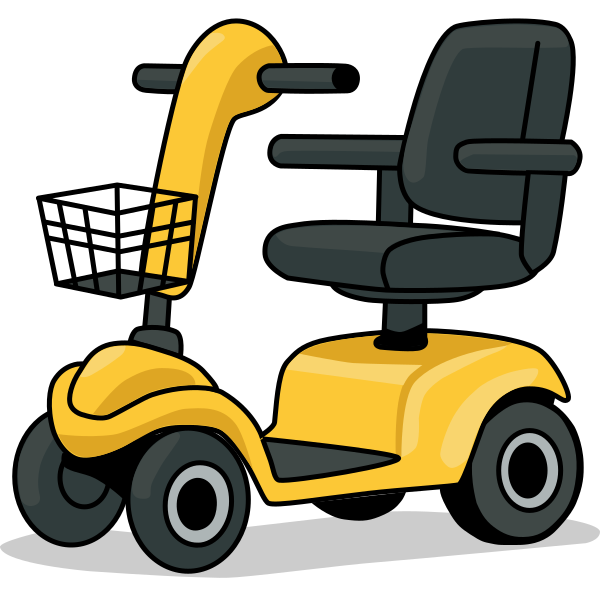

Almost every mobility scooter sold in the UK is a Class 2. These are the 4 mph pavement scooters you see outside supermarkets and on the high street: no DVLA registration, no licence, no road tax, and no legal requirement for lights or mirrors. You buy one, you charge it, you use it.
That simplicity is the whole appeal, and it is also why the category is so hard to shop. There are 78 current Class 2 models in our database against 52 Class 3s, they span £530 to £5,995, and the differences between them are much less obvious than the Class 2 versus Class 3 decision that gets all the attention.
This guide covers the best Class 2 mobility scooters in the UK in 2026, chosen for the things that actually vary within the class: range, how easily the scooter comes apart, suspension, weight capacity, and battery type.
What Class 2 Actually Means
Class 2 is a legal category, not a marketing one. The definition is narrow and it is worth knowing before you compare models.
| Class 2 | Class 3 | |
|---|---|---|
| Maximum speed | 4 mph | 8 mph (4 mph on pavements) |
| Intended use | Pavements and pedestrian areas | Roads and pavements |
| DVLA registration | Not required | Required (free, V55/5) |
| Lights and indicators | Not required | Required |
| Mirrors | Not required | Required |
| Minimum age | 14 | 14 |
| Typical range | 6-27 miles | 20-45 miles |
| Typical price | £530-£3,000 | £1,300-£8,000 |
The practical consequence is that a Class 2 scooter is a walking-pace machine for local journeys. It will take you to the shops, around a town centre, along a promenade, and to appointments. It is not transport for travelling along roads, and if that is what you need, our Class 3 roundup covers the road-legal alternatives.
For the rules on where you can and cannot ride, see our guide to pavement and road rules, and for the licensing position, our licensing guide. The Class 2 reference page has the full legal definition.
What to Look For in a Class 2 Scooter
Speed is fixed at 4 mph across the whole class, so it tells you nothing. These are the specifications that separate one Class 2 scooter from another.
Range
This is the widest spread in the category. Budget models manage 6 to 10 miles; the best reach 25 to 27. Since a Class 2 scooter is doing short local trips, 10 miles is genuinely enough for many people — but range collapses in cold weather, on hills, and as the battery ages, so treat 70-80% of the quoted figure as your working distance.
If you regularly cover more than about 12 miles in a day, buy for range rather than price. Our longest-range roundup covers the models that stretch furthest across all classes.
How it comes apart
Most Class 2 scooters are take-apart rather than folding: the seat lifts off, the battery pack lifts out, and the chassis splits into two pieces. The number that matters is the heaviest piece, because that is what someone has to lift into a car boot. Anything under about 12 kg is manageable for most people; 18 to 20 kg is not.
A minority are true folding scooters, which collapse in one movement and are usually lighter overall but more expensive. Our foldable scooter buying guide explains the trade-off, and the car boot roundup is the place to start if transport is your main concern.
Suspension
At 4 mph, suspension matters less than it does on a Class 3, but it is not irrelevant — dropped kerbs, paving slabs and cobbles all transmit straight through an unsuspended frame. Roughly half the Class 2 market has no suspension at all, and it is the single most common thing missing from budget models.
Weight capacity
Most Class 2 scooters support 115 to 136 kg (18 to 21 stone). A handful reach 160 kg and above. If you are within about 15 kg of a model's rating, move up a size — running a scooter near its limit costs you range, hill-climbing and battery life. Our heavy-duty roundup covers the higher-capacity options in detail.
Battery type
Sealed-lead-acid is the default and it is fine, but it is heavy and lasts 1-2 years. Lithium-ion costs more, weighs roughly half as much for the same capacity, lasts 3-5 years, and is what makes the lightest scooters possible. Lithium is also the only type generally accepted for air travel. See our battery guide for care and replacement.
Our Top Picks
These eight cover the main Class 2 use cases. If your budget is firmly under £1,000, our best mobility scooters under £1,000 guide ranks that tier specifically and in more depth than this roundup does.
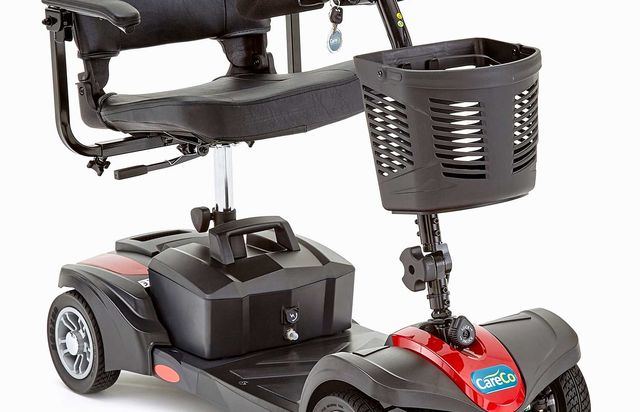
1. CareCo Zoom Plus - Best Budget
The Zoom Plus is the standard Zoom with a much larger 20 Ah battery, and that one change makes it the best-value long-range option under £1,000. 14 miles is more than most scooters costing half as much again, and the puncture-proof solid tyres remove the most common maintenance job on a budget scooter.
Key specs:
| Spec | Value |
|---|---|
| Price | £900 |
| Speed | 4 mph |
| Range | 14 miles |
| Weight capacity | 130 kg |
| Weight (with batteries) | 47 kg |
| Heaviest piece | 18 kg |
| Suspension | None |
| Wheels | 4 |
| Tyres | Solid (puncture-proof) |
| Battery | Sealed-lead-acid (20 Ah) |
| Warranty | 2 years |
Why it stands out: 14 miles at £900 is the best range-per-pound in the sub-£1,000 bracket. The delta tiller is easier on arthritic hands than a standard thumb lever, and it dismantles into five sections.
Trade-offs: No suspension, and on solid tyres you will feel that. No lights or basket included. The 18 kg heaviest piece is at the top of what most people can lift, and the 140 cm turning radius is wide for indoor use.
2. Drive DeVilbiss Envoy 4 - Best Value for Range
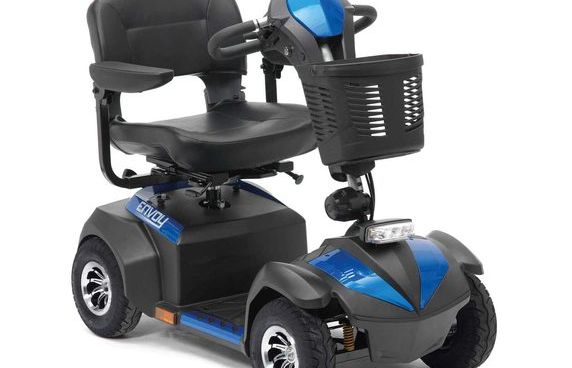
The Envoy 4 delivers 25 miles — within 2 miles of the longest-range Class 2 scooter on the market — with full suspension and a 159 kg weight capacity, for £1,285. Nothing else comes close on range for the money.
Key specs:
| Spec | Value |
|---|---|
| Price | £1,285 |
| Speed | 4 mph |
| Range | 25 miles |
| Weight capacity | 159 kg |
| Weight | 94 kg |
| Suspension | Full |
| Wheels | 4 |
| Tyres | Pneumatic |
| Battery | Sealed-lead-acid (34 Ah) |
| Seat | Captain |
| Warranty | 2 years |
Why it stands out: 25 miles, full suspension, a captain's seat and delta handlebars at under £1,300 is an unusual combination. The 159 kg capacity is higher than almost anything else at this price.
Trade-offs: At 94 kg it does not disassemble and is not going in a car. This is a scooter that lives at home and is ridden from the door. Pneumatic tyres ride better but can puncture.
Drive sells the same chassis as the road-legal 8 mph Envoy 8 for £1,804. If you are weighing pavement-only against road access, our Envoy 4 vs Envoy 8 comparison isolates exactly what the Class 3 upgrade costs, because the two scooters are otherwise identical.
3. Drive DeVilbiss AstroLite - Best for Car Boot Loading
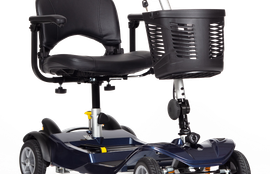
The AstroLite is built around one number: the heaviest piece weighs 9.9 kg. That is the lightest of any splittable scooter Drive makes, and it puts boot loading within reach of people who cannot manage the 18-20 kg pieces typical of the category. It also has full suspension and a lithium battery, neither of which is common at this weight.
Key specs:
| Spec | Value |
|---|---|
| Price | £1,396 |
| Speed | 4 mph |
| Range | 11.4 miles |
| Weight capacity | 120 kg |
| Weight (with battery) | 27.6 kg |
| Heaviest piece | 9.9 kg |
| Suspension | Full |
| Wheels | 4 |
| Tyres | Solid |
| Battery | Lithium-ion (17.2 Ah) |
| Warranty | 2 years |
Why it stands out: A 9.9 kg heaviest component with full suspension is a genuinely rare combination. The lithium battery is approved for air travel, and there is a larger battery option if you need more than 11.4 miles.
Trade-offs: The 120 kg weight capacity is one of the lowest here. The smaller battery option drops range to 6.8 miles, so check which one you are being quoted. Premium price for the range you get.
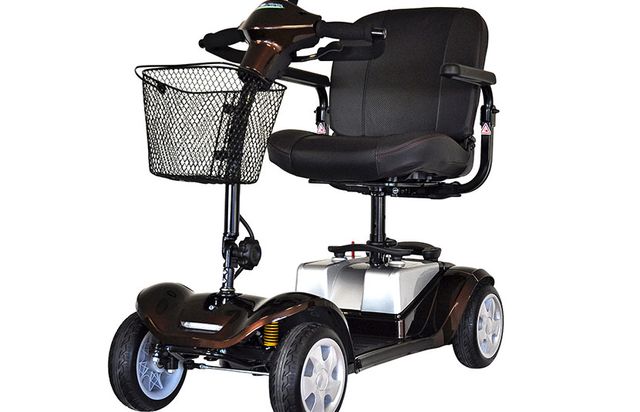
4. Kymco Mini Comfort - Best Comfort Under £2,000
The Mini Comfort is the sensible middle of the Class 2 market: 16 miles, full suspension, LED lights front and rear, and a 122 cm turning radius that makes it usable inside shops. It is a take-apart travel scooter that does not feel like a compromise.
Key specs:
| Spec | Value |
|---|---|
| Price | £1,757 |
| Speed | 4 mph |
| Range | 16 miles |
| Weight capacity | 127 kg |
| Weight (with batteries) | 54 kg |
| Heaviest piece | 19.5 kg |
| Suspension | Full |
| Wheels | 4 |
| Tyres | Solid |
| Battery | Sealed-lead-acid (22 Ah) |
| Warranty | 2 years |
Why it stands out: 16 miles with full suspension and lights fitted as standard, at a price where many rivals still have no suspension. The tight turning circle is a real advantage in supermarket aisles.
Trade-offs: The 19.5 kg heaviest piece undercuts the "travel scooter" billing — this is a two-person lift for many people. Sealed-lead-acid keeps the total weight at 54 kg. The low seat height does not suit taller riders.
5. Rascal Vierra LiFe - Best All-Rounder
The Vierra LiFe is the most complete Class 2 scooter here. 26 miles of range, a 10.8 kg heaviest piece, full suspension, a 115 cm turning radius, and a LiFePO4 battery with a lifetime guarantee. It is close to the longest-range Class 2 scooter available and simultaneously one of the easiest to load into a car — a combination nothing else in this roundup manages.
Key specs:
| Spec | Value |
|---|---|
| Price | £1,895 |
| Speed | 4 mph |
| Range | 26 miles |
| Weight capacity | 136 kg |
| Weight (with battery) | 33.8 kg |
| Heaviest piece | 10.8 kg |
| Suspension | Full |
| Wheels | 4 |
| Tyres | Solid |
| Battery | Lithium-ion LiFePO4 (25 Ah) |
| Warranty | 1 year (lifetime battery guarantee) |
Why it stands out: 26 miles from a 33.8 kg scooter that splits into a 10.8 kg heaviest piece is the standout specification in the whole Class 2 category. The 115 cm turning radius is the tightest here, and the lifetime battery guarantee removes the biggest long-term running cost.
Trade-offs: 4.5 cm of ground clearance is very low — this scooter does not like grass, gravel or steep dropped kerbs. The scooter warranty is only 1 year, against 2 or 3 from most rivals. No lights fitted as indicators or mirrors.
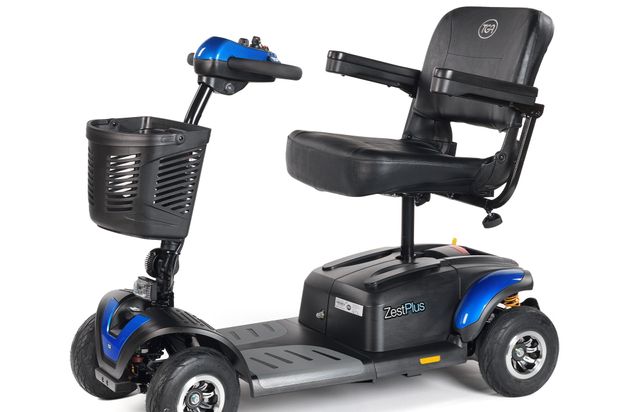
6. TGA Zest Plus - Best for Larger Riders
The Zest Plus takes TGA's Zest and adds a 420 W motor, 33 Ah batteries and a 160 kg weight capacity. It is the highest-capacity pick in this roundup, pairs that with 20 miles of range and full suspension, and carries a 3-year warranty — the longest here.
Key specs:
| Spec | Value |
|---|---|
| Price | £1,995 |
| Speed | 4 mph |
| Range | 20 miles |
| Weight capacity | 160 kg |
| Weight | 74 kg |
| Ground clearance | 10 cm |
| Suspension | Full |
| Wheels | 4 |
| Tyres | Pneumatic |
| Battery | Sealed-lead-acid (33 Ah) |
| Warranty | 3 years |
Why it stands out: 160 kg capacity with 20 miles of range and full suspension, backed by a 3-year warranty. The 10 cm ground clearance is more than double the Vierra LiFe's, so it copes with rougher surfaces and steeper kerbs.
Trade-offs: At 74 kg with a larger footprint than the standard Zest, transport needs a hoist or ramp. Pneumatic tyres need pressure checks. If you need more than 160 kg, you are into heavy-duty territory and most of those models are Class 3.
7. eFOLDi Compass - Best Folding
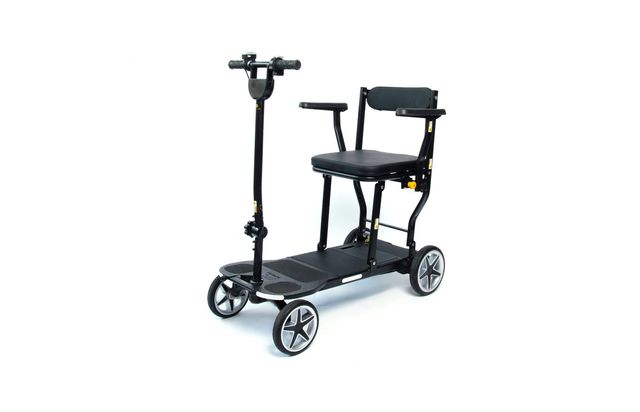
The Compass is a magnesium-alloy folding scooter that weighs 13 kg with its battery — less than half of any take-apart model here, and light enough to lift into a boot in one piece. It bi-folds in seconds rather than dismantling into sections, and the battery is Airsafe-approved for flights.
Key specs:
| Spec | Value |
|---|---|
| Price | £2,499 |
| Speed | 4 mph |
| Range | 10 miles |
| Weight capacity | 120 kg |
| Weight (with battery) | 13 kg |
| Suspension | None |
| Wheels | 4 |
| Tyres | Solid |
| Battery | Lithium-ion (7-year warranty) |
| Foldable | Yes |
| Warranty | 2 years |
Why it stands out: 13 kg is the lowest all-up weight in Class 2, and folding in one movement beats a five-section dismantle every time you use it. The air-travel-approved battery and 7-year battery warranty make it the obvious choice for regular travellers.
Trade-offs: £2,499 is a lot for 10 miles of range and a 120 kg limit. No suspension, no lights, no basket. It is a specialist portable scooter, not an all-day one.
Two of our comparisons put it head to head with its closest rivals: Kymco K-Lite FE vs eFOLDi Compass and eFOLDi Compass vs Pride Go-Go.
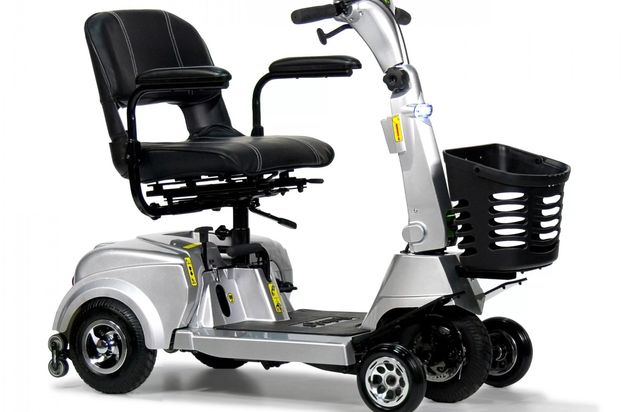
8. Quingo Ultra 2 - Best Stability
The Ultra 2 is the only five-wheel scooter in this roundup. Quingo's Quintell layout puts two extra wheels at the front, which spreads the load and resists tipping on cambered pavements and side slopes — the situation where a conventional four-wheel scooter feels least secure. Despite that, the heaviest component is 17 kg and it takes apart for transport.
Key specs:
| Spec | Value |
|---|---|
| Price | £2,995 |
| Speed | 4 mph |
| Range | 18 miles |
| Weight capacity | 133 kg |
| Heaviest piece | 17 kg |
| Suspension | Front |
| Wheels | 5 |
| Tyres | Solid |
| Battery | Sealed-lead-acid |
| Warranty | 1 year |
Why it stands out: No other take-apart scooter offers this level of anti-tip stability. If you are nervous on cambered pavements, or have had a scooter feel unsteady before, the five-wheel layout addresses that directly.
Trade-offs: £2,995 is the most expensive pick here, the 133 kg capacity is mid-range, the warranty is only 1 year, and front-only suspension is modest at the price. Quingo's dealer network is smaller than Drive's or Pride's — see our Quingo brand guide for the full range.
Quick Comparison Table
| Model | Price | Range | Capacity | Weight | Heaviest piece | Suspension | Battery | Best For |
|---|---|---|---|---|---|---|---|---|
| CareCo Zoom Plus | £900 | 14 mi | 130 kg | 47 kg | 18 kg | None | Lead-acid | Budget |
| Drive Envoy 4 | £1,285 | 25 mi | 159 kg | 94 kg | n/a | Full | Lead-acid | Value + range |
| Drive AstroLite | £1,396 | 11.4 mi | 120 kg | 27.6 kg | 9.9 kg | Full | Lithium | Boot loading |
| Kymco Mini Comfort | £1,757 | 16 mi | 127 kg | 54 kg | 19.5 kg | Full | Lead-acid | Comfort |
| Rascal Vierra LiFe | £1,895 | 26 mi | 136 kg | 33.8 kg | 10.8 kg | Full | Lithium | All-rounder |
| TGA Zest Plus | £1,995 | 20 mi | 160 kg | 74 kg | n/a | Full | Lead-acid | Larger riders |
| eFOLDi Compass | £2,499 | 10 mi | 120 kg | 13 kg | 13 kg (folds) | None | Lithium | Folding |
| Quingo Ultra 2 | £2,995 | 18 mi | 133 kg | n/a | 17 kg | Front | Lead-acid | Stability |
All eight are limited to 4 mph. None requires DVLA registration or a licence.
Which Scooter for Which Situation?
Local trips from home, no car involved
If the scooter never needs to go in a vehicle, ignore weight entirely and buy range, comfort and capacity instead. This is where most people over-specify portability they will never use.
- Best choice: Drive Envoy 4 (25 miles, full suspension, 159 kg, £1,285)
- Budget choice: CareCo Zoom Plus (14 miles, £900)
Loading into a car boot regularly
The heaviest single piece is the only number that matters, and it needs to be one you can lift repeatedly, not once in a showroom.
- Best choice: Rascal Vierra LiFe (10.8 kg heaviest piece, and still 26 miles of range)
- Alternative: Drive AstroLite (9.9 kg heaviest piece, lower range)
- If you would rather fold than dismantle: eFOLDi Compass (13 kg, one movement)
Our car boot roundup and lightweight travel guide go into boot dimensions and loading technique in more detail.
Flying or taking the train
Airlines require lithium batteries with the correct certification, and most Class 2 scooters use sealed-lead-acid. That narrows the field sharply.
- Best choice: eFOLDi Compass (Airsafe-approved battery, folds in seconds)
- Alternative: Drive AstroLite (lithium, air-travel approved, splits into pieces)
See taking your scooter on public transport for train and bus size limits, which most full-size Class 2 scooters exceed.
Heavier riders
- Up to 160 kg: TGA Zest Plus
- Above 160 kg: the Class 2 options thin out quickly and most higher-capacity scooters are Class 3. Start with our heavy-duty roundup.
Uneven pavements, cambers and kerbs
Ground clearance and wheel layout matter more than suspension here.
- Best choice: Quingo Ultra 2 (five wheels, anti-tip)
- Alternative: TGA Zest Plus (10 cm ground clearance, full suspension)
- Avoid: anything with 4.5-6 cm of clearance if your route includes rough ground
Wheel count also affects stability and turning circle in ways that are easy to get wrong — our 3-wheel vs 4-wheel guide covers the trade-off.
Other Class 2 Models Worth Considering
Our eight picks cover the main use cases, but the class runs to 78 current models. A few others are worth a look:
- Rascal Luxe (£2,150) - 27 miles, the longest range of any Class 2 scooter we list, with full suspension, lithium batteries and a 10.8 kg heaviest piece. Effectively a Vierra LiFe with more range for £255 more.
- TGA Zest S (£2,295) - a 168 kg weight capacity, the highest in Class 2, with 20 miles of range and full suspension.
- Kymco Komfy 4 (£2,465) - 25 miles and a 160 kg capacity on a full-size pavement chassis, for people who want Envoy 4 range with a more comfortable seat.
- Drive DeVilbiss Compact Lite (£530) - the cheapest Class 2 scooter we list. 8 miles, no suspension, but a genuine take-apart scooter at a price nothing else matches. Covered in our under £1,000 guide.
Legal Requirements
Class 2 scooters are the lightly regulated end of the market, which is most of the appeal.
No registration, no licence
Class 2 scooters do not need to be registered with the DVLA, and you do not need a driving licence, road tax, or an MOT. Registration applies only to Class 3. The only legal requirement on the rider is a minimum age of 14.
Where you can ride
- Pavements and pedestrian areas - yes, this is what Class 2 is for
- Crossing a road - yes
- Travelling along a road - only where there is no pavement, and you should keep to the direction of traffic and leave the road as soon as a pavement is available
- Cycle lanes - generally yes, though local rules vary
- Motorways and dual carriageways - no
- Bus lanes - no
Our pavement and road rules guide covers the detail, including shops, parks and pedestrianised zones.
Lights and equipment
Class 2 scooters are not legally required to carry lights, indicators or mirrors. In practice, if you ride after dark you should have lights regardless of the law — five of our eight picks include them as standard.
Insurance
Insurance is not required by law, but third-party cover matters more than people expect: at 4 mph on a busy pavement, the realistic risk is injuring a pedestrian or damaging a shop display. Basic policies start at around £50 per year and usually include theft and breakdown recovery.
Running Costs
Class 2 scooters are cheaper to run than Class 3 models — smaller batteries, lighter build, less servicing. Use our running cost calculator for a personalised figure, but as a guide:
| Cost | Annual Estimate |
|---|---|
| Electricity (charging) | £10-£25 |
| Insurance (optional) | £50-£120 |
| Servicing | £60-£120 |
| Battery replacement (every 1-2 years for lead-acid) | £100-£220 |
| Tyre replacement / repair | £0-£60 |
| Total | £220-£545 |
Solid tyres remove the puncture cost entirely, which is why five of our eight picks use them. Lithium models (AstroLite, Vierra LiFe, eFOLDi Compass) cost more to replace but last 3-5 years instead of 1-2, and the Vierra LiFe's lifetime battery guarantee removes that line altogether.
For broader pricing context, see our average mobility scooter prices data and cost guide.
How We Chose These Scooters
Every model in this roundup meets four criteria:
- Class 2 with a 4 mph limit, pavement-legal without registration
- Available in the UK from brands with dealer networks and warranty support
- Currently in production, with parts and servicing available
- Published price and full specifications, so the comparison is like for like
We selected eight from the 78 current Class 2 models in our database, choosing one for each major use case: budget, range value, boot loading, comfort, all-round, weight capacity, folding, and stability. Because the under £1,000 guide already ranks the budget tier in depth, this roundup deliberately weights toward the £1,000-£3,000 range where the specification differences are larger and less well covered.
Frequently Asked Questions
What is a Class 2 mobility scooter?
A Class 2 mobility scooter is limited to 4 mph and designed for pavement use. It does not need DVLA registration, does not require a driving licence, and is not legally required to have lights, indicators or mirrors. Class 2 covers the large majority of scooters sold in the UK.
Do you need to register a Class 2 mobility scooter?
No. Registration with the DVLA applies only to Class 3 scooters. There is no road tax, no MOT and no licence requirement for a Class 2. See our licensing guide for the full position.
Can you take a Class 2 mobility scooter on the road?
Class 2 scooters are for pavements. You may cross a road, and you may travel along one where there is no pavement, but you should return to the pavement as soon as there is one. If you need routine road use, you need a Class 3 scooter.
How fast does a Class 2 mobility scooter go?
4 mph, roughly a brisk walking pace. A few models are advertised at 4.1-5.2 mph because the manufacturer quotes an unrestricted figure, but 4 mph is the legal limit for pavement use in the UK and UK-supplied scooters are limited accordingly.
How much does a Class 2 mobility scooter cost?
From about £530 to £5,995, with most buyers between £900 and £2,500. Under £1,000 buys a functional take-apart scooter with modest range and no suspension. Between £1,500 and £2,500 you are paying for suspension, lithium batteries, longer range, and a lighter heaviest piece.
Is a Class 2 or Class 3 scooter better?
Neither is better — they answer different questions. A Class 2 is lighter, cheaper, needs no registration, and is easier to transport and store. A Class 3 travels at 8 mph on roads, goes 20-45 miles, and carries more weight, but must be registered, needs lights and mirrors, and typically weighs 80-165 kg. If your journeys are local and pavement-based, Class 2 is the right answer.
What is the longest-range Class 2 mobility scooter?
The Rascal Luxe at 27 miles, followed by the Rascal Vierra LiFe at 26 miles and the Drive Envoy 4 at 25 miles. Quoted ranges assume flat ground, a light rider and a new battery, so plan on 70-80% of the figure. Our longest-range roundup compares the best across all classes.
Do you need insurance for a Class 2 scooter?
Not legally, but it is worth having. Third-party cover protects you if you injure a pedestrian or damage property, and most policies bundle theft cover and breakdown recovery. Basic cover starts at around £50 per year — see our insurance guide.
Can a Class 2 mobility scooter go on grass?
Some can, most struggle. Ground clearance is the limiting factor: models at 4.5-6 cm will ground out on soft or uneven surfaces, while 10 cm (the TGA Zest Plus) copes far better. For genuinely rough terrain you want a purpose-built model — see our off-road guide.
Related Models
Drive DeVilbiss
AstroLite
eFOLDi
Compass
Drive DeVilbiss
Envoy 4
Kymco Healthcare
Mini Comfort
Quingo
Ultra 2

Rascal Mobility
Vierra LiFe
TGA Mobility
Zest Plus
CareCo